

Why Sepang made Mercedes’ F1 upgrade hard to judge
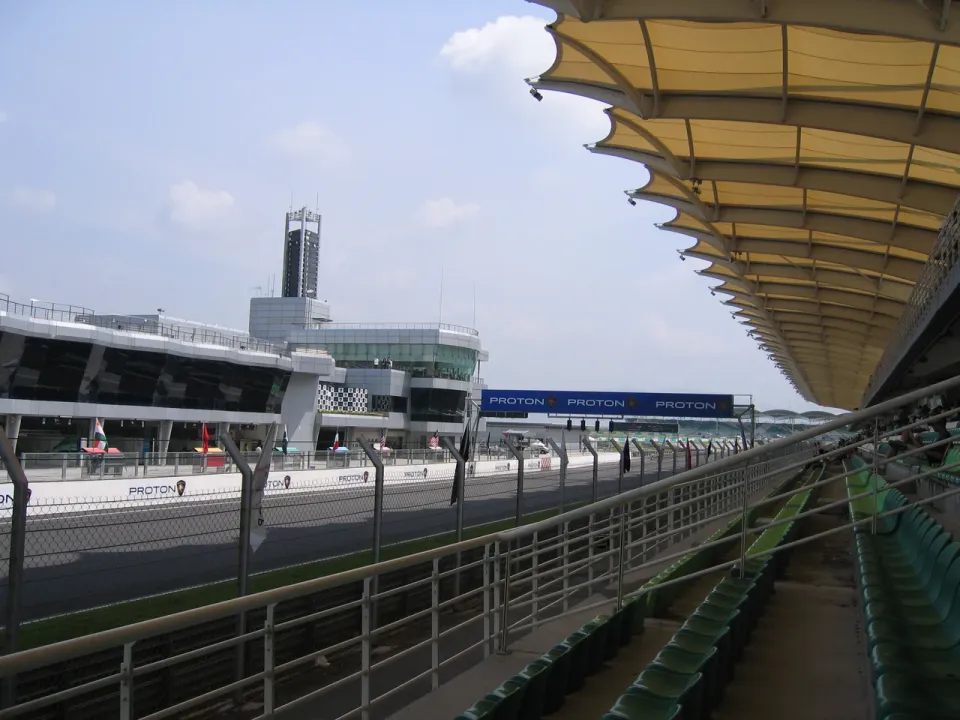
Archive photograph: Sepang International Circuit · main straight and grandstands, 2007 · 2007-11-25Archive photo · 2007-11-25 · mondayblues · CC BY-SA 3.0
Sepang’s rough surface complicated Mercedes’ assessment of its revised floor and sidepods, adding tyre heat and potentially altering airflow beneath the car.
At Sepang, Mercedes found its revised floor and sidepods difficult to assess during Formula 1’s Bahrain Grand Prix in Malaysia. The circuit’s rough surface contributed to excess tyre heat and may also have altered airflow beneath the car; Mercedes also struggled to reach its usual pace.
Mercedes introduced the package when Formula 1 returned to Sepang for the first time in nine years. The team said it was pleased with the update’s performance in higher-speed corners, but the W17 struggled overall, particularly in slower turns. Mercedes looked set for a double podium before George Russell retired with a powertrain issue.
Deputy team principal Bradley Lord said the update, track temperature and surface may have interacted, leaving the car “not in its usual happy state”. In slower corners, he said, drivers had to use the throttle to turn the car, further worsening tyre-temperature challenges.
At the contact patch, the rough surface can make a tyre deform to fill gaps in the road. That movement creates grip, but repeated loading and unloading of the contact patch—a process called hysteresis—also dissipates energy as heat. Greater deformation raises heat at the tyre surface.
A second, more tentative possibility is aerodynamic; McLaren team principal Andrea Stella had hinted at that angle. Airflow accelerated beneath an F1 car helps generate downforce, and track texture can change how it behaves. The resulting change to the boundary layer may bring turbulence or flow separation. Teams are likely to factor surface roughness into simulations.
Lord said Mercedes needed to untangle those interactions to establish whether the update was working and whether development was heading in the right direction for the 2026 car and the 2027 car.
Sources 01
- SOURCEThe mechanisms at play behind Mercedes' difficult Bahrain GP weekendMotorsport.com F1
This article was produced with AI assistance. Source references make its supporting evidence traceable.
Read also
Mercedes still working to understand why upgraded W17 struggled at Sepang
Schiff warns Mercedes power-unit problems could cost Antonelli more wins
Antonelli: Mercedes still cannot judge its Sepang upgrade
Antonelli still washes his own car by hand as F1 title chance nears
Austin offers free F1 fan zones beyond the circuit